
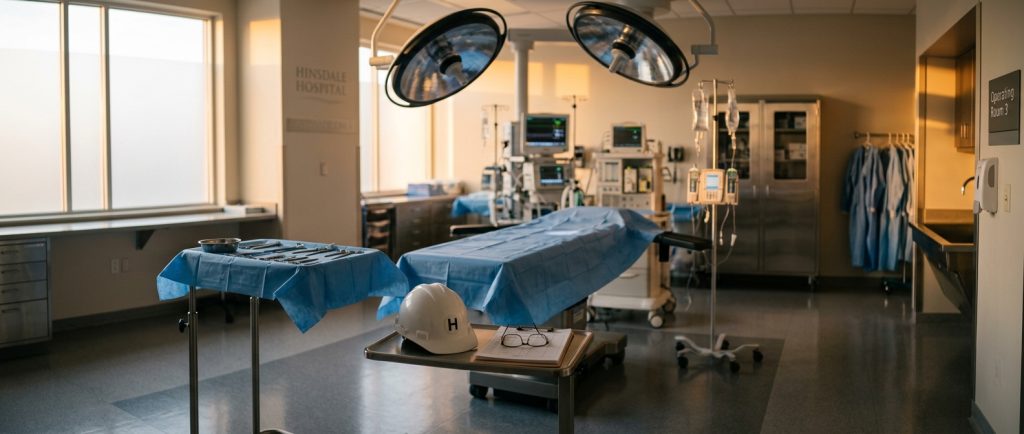
“I slipped in the hospital hallway and tore my quadriceps. I spent my life caring for patients — and when I needed help, the hospital turned its back. My lawyer reminded me that those who care also deserve to be cared for.”
The Origin of the Claim: Quadriceps Tendon Rupture at Hinsdale Hospital
A 56-year-old nurse with 22 years of service at Hinsdale Hospital suffered a complete rupture of the right quadriceps tendon after slipping on a freshly waxed floor in the ICU hallway in November 2022. The tendon — which connects all four thigh muscles to the kneecap — tore completely, requiring open repair surgery with bone anchors and a 9-month rehabilitation protocol. A quadriceps rupture is one of the most severe knee-adjacent injuries: unlike a fracture that heals predictably or a meniscus tear that can be repaired, the quadriceps rarely recovers 100% of its strength. As a result, this type of knee injury often means permanent limitations.
The nurse faced a brutal reality: 6 weeks with the leg completely immobilized, 4 months of intensive physical therapy, and a high probability of a permanent limp and 20-30% strength loss. For an ICU nurse who spends 12-hour shifts on his feet, this meant the possible end of his career. Ironically, Illinois healthcare workers have one of the highest workplace injury rates — second only to construction and manufacturing — but one of the lowest rates of successful compensation claims. The “care for others first” culture leads many healthcare workers to minimize their own injuries or accept inadequate settlements.
The Obstacles: When Your Employer Is a Hospital
The hospital — his employer for 22 years — treated his injury as an administrative incident. The insurer Broadspire questioned the severity of the rupture, arguing that a slip on a wet floor could not cause a complete tear and suggesting — without evidence — that the tendon must have been pre-weakened by a degenerative condition. The nurse, who had dedicated over two decades to that institution, found himself treated as an adversary rather than a loyal employee. Multiple colleagues suggested he “not make waves” and accept whatever the hospital offered. His direct supervisor reminded him — in an email later used as evidence — that “the hospital has been good to you for 22 years” and that he “shouldn’t take this to a legal forum.” This type of informal pressure is common in healthcare and constitutes the kind of workplace intimidation the IWCC takes seriously under Section 4(h) of the Act.
Legal Strategy: Liability Without Exceptions
The attorneys at Illinois Compensation obtained — through a formal evidence preservation request — the hospital’s maintenance records showing the ICU hallway had been waxed 40 minutes before the accident without placement of “wet floor” signage. This was a direct violation of both the hospital’s own safety protocols and OSHA standards for healthcare facilities. The supervisor’s email discouraging the worker from pursuing legal remedies was presented to the IWCC arbitrator as evidence of a workplace environment that pressured injured employees not to exercise their rights — a violation of the Illinois Workers’ Compensation Act’s anti-retaliation provisions.
The combination of documented safety violations and evidence of workplace intimidation transformed the case from a disputed injury into a clear instance of employer liability. The hospital’s own records — maintenance logs and supervisor emails — became the strongest evidence against it.
The Victory: $64,000 for the Hinsdale Nurse
The case settled for $64,000. The settlement covered the quadriceps tendon repair surgery, 9 months of physical therapy and rehabilitation, temporary total disability (TTD) for the entire recovery period, and permanent partial disability (PPD) calculated on 25% impairment of the right leg. Beyond the settlement, the case had a significant collateral effect: the hospital implemented new wet-floor signage policies and reviewed its workplace accident reporting protocols — making the facility safer for every nurse working that ICU hallway.
With rehabilitation complete and compensation secured, the nurse returned to his ICU position at Hinsdale Hospital. The limp is minimal, and while his strength isn’t what it was, 22 years of experience make him irreplaceable. The compensation allowed him to heal without rushing — and to return when he was truly ready, not when the hospital was pressuring him.
Are you a healthcare worker whose hospital is minimizing your workplace injury? Hospitals are experts at caring for patients — but sometimes they treat their own employees like a number. If you suffered a knee, back, shoulder injury, or any workplace accident at a hospital, clinic, or healthcare facility in Illinois, our firm knows that those who care also deserve to be cared for. Don’t let 20 years of loyalty convince you to accept less than you deserve.
Call us today for a free consultation. We don’t back down — and neither should you.